The short answer
Brain fog is not a diagnosis — it is a symptom with a shortlist of everyday causes. The most common: fragmented sleep, chronic stress hormones, the hormonal shifts of perimenopause and menopause, medication side effects, dehydration and blood-sugar swings. Each one degrades attention — and what feels like memory loss is usually information that never got encoded in the first place. Most fog responds to fixing the underlying driver; fog that is constant, worsening or paired with other symptoms deserves bloodwork and a doctor, because thyroid, B12 and sleep apnea are on the same shortlist.

It is the afternoon where the screen swims and the sentence you just read needs reading again. The meeting where you hear every word and retain none. The cotton-wool layer between you and your own thoughts. "Brain fog" is not a medical term, but everyone over fifty who has felt it knows exactly what it means — and the good news is that it usually has ordinary, addressable causes.
Fog is mostly an attention problem wearing a memory costume
Here is the mechanism worth understanding: things you do not attend to never become memories at all. When something dulls attention — exhaustion, stress, hormones — information passes through without being written down. Later, when you cannot recall the conversation, it feels like your memory failed. It did not. The encoding never happened. That is why the fix for fog starts with whatever is stealing attention, not with trying harder to remember.
The usual suspects
- Fragmented sleep. Deep sleep is when the brain consolidates the day's memories and clears metabolic waste. Sleep gets lighter and more interrupted with age — and even one bad night measurably dents next-day attention and working memory. Untreated sleep apnea, which rises sharply after 50, produces exactly the daytime fog people describe.
- Chronic stress. Short bursts of cortisol sharpen you; a constant drip does the opposite, impairing the hippocampus — the brain's memory hub — and hogging working memory with background worry. It also burns through dopamine and norepinephrine, the chemicals attention runs on, faster than they are rebuilt. Fog under sustained stress is your brain running heavy software in the background on a low battery.
- Perimenopause and menopause. Estrogen interacts with acetylcholine, serotonin and cerebral blood flow. As it declines, up to two-thirds of women report fog, word-finding pauses and concentration dips. It is real, measurable in studies — and for most women it improves after the transition stabilizes.
- Medications. Common culprits after 50: sleep aids, older antihistamines, some blood-pressure drugs, strong anticholinergics for bladder or allergies. If fog started around a prescription change, that is a conversation with your doctor or pharmacist — never stop a medication on your own.
- Fuel problems. The brain is 2% of body weight burning 20% of the energy. Dehydration of even 1–2%, skipped meals and blood-sugar rollercoasters all show up first as fuzzy thinking — and they land hardest in the early afternoon, when alertness naturally dips anyway.
What actually helps
- Protect the first hour of sleep hygiene, not the last hour of willpower. Fixed wake time, dark cool room, no alcohol within three hours of bed — and if you snore or wake unrefreshed daily, ask about a sleep study. Treating apnea lifts fog like a curtain.
- Move, daily and modestly. A brisk 30-minute walk increases cerebral blood flow immediately and grows hippocampal volume over months. It is the single best-evidenced fog intervention that exists.
- Feed the machine on schedule. Regular meals with protein, water within reach all day, and caffeine before noon only — late caffeine pays for today's clarity with tonight's sleep. (If your fog is specifically a 3 p.m. event, we unpacked it in why your focus fades at 3 p.m..)
- Close the stress loops. Ten minutes of walking outside, breathing exercises or simply writing worries down measurably frees working memory. Fog thins when the background software quits.
- Audit the medicine cabinet. Bring the full list — including over-the-counter sleep and allergy aids — to your next appointment and ask what could be contributing.
When fog deserves a real investigation
See a doctor rather than reaching for any product if the fog is constant rather than fluctuating, clearly worsening over months, or paired with other signals: unexplained weight change, hair loss or cold intolerance (thyroid), numbness or tingling (B12), loud snoring with daytime sleepiness (apnea), low mood and loss of interest (depression — which in older adults often shows up as memory complaints first). Every one of those is common, testable and treatable — which is exactly why guessing is the wrong strategy.
Where nutritional support fits
Once the fundamentals are addressed, the attention side of the problem is a fair target: fog is, at bottom, an alertness-and-focus shortfall, and both run on chemistry that stress and age leave in shorter supply. That is the logic behind studied ingredients such as morning sources of natural caffeine (guarana seed, green tea leaf) for alertness — taken early so they do not cost you sleep — L-tyrosine, the amino acid the brain converts into the attention chemicals a hard day burns through, and ginseng root, the traditional daily companion for concentration. Support of that kind is a complement to sleep, movement and medical checkups — never a replacement for them.
Our recommendation: CogniClear
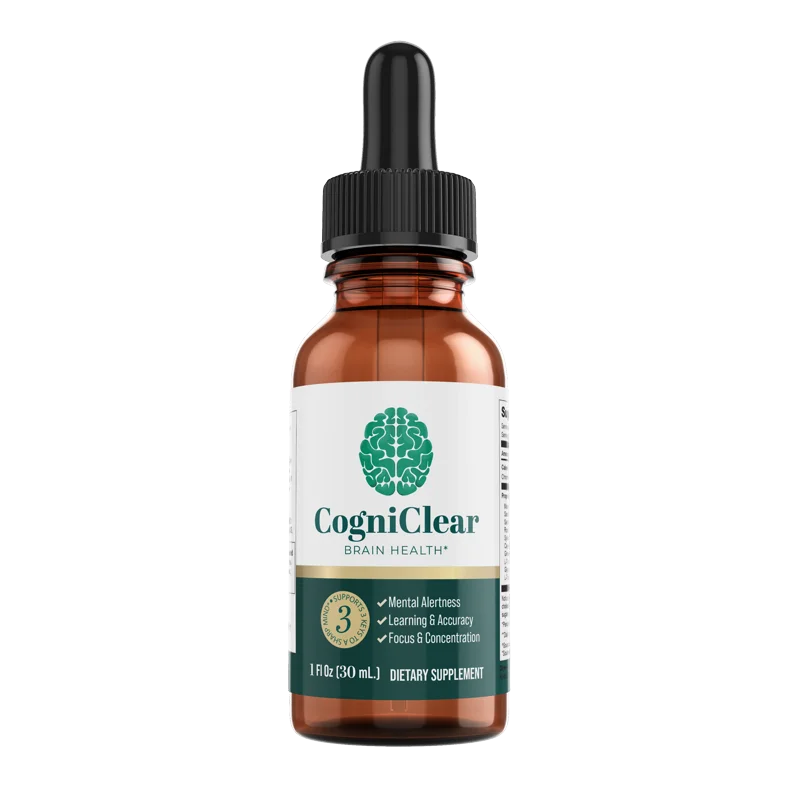
Once sleep, movement and a checkup are covered, if the fog still dulls your focus by mid-afternoon, CogniClear is the morning formula we recommend. It puts the ingredients above into one measured morning dose:
- Guarana seed and green tea leaf — the natural caffeine pair behind its mental-alertness key, with green tea’s gentler character.
- Ginseng root, L-tyrosine, eleuthero and astragalus — the focus-and-concentration names that support you on demanding days.
- Chromium, L-carnitine, GABA and more named botanicals — every one printed on the panel.
- Simple morning routine — two droppers, about 1 mL, once a day with breakfast or your first coffee. A flavored, zero-calorie liquid sweetened with xylitol and stevia.
Because it contains caffeine, count it as one of your morning cups and keep it before noon; that is exactly what the morning-only design is for. Bundles start at $33 per bottle on the 3-bottle bundle ($99 total), 2 bottles are $89 and 1 bottle is $79, all with free shipping, and the official checkout offers a 90-day money-back guarantee. Small notes: the pricing and guarantee apply only at the official checkout, so review your order summary before paying, and like any daily routine it works best with a few weeks of consistency.
Official checkout · 90-day money-back guarantee · free shipping
Related reading
Memory loss in women at 40 under stress
Why forgetfulness peaks in a woman's early 40s — perimenopausal estrogen swings meeting chronic stress — what helps, and the red flags that deserve a doctor.
Read the article →Why names slip your mind after 50
How recall actually works, why retrieval slows before anything is wrong, and the red flags that deserve a doctor instead of a supplement.
Read the article →7 daily habits with real evidence for a sharper memory
Sleep, movement, learning, diet and stress — ranked honestly by the strength of the science, plus where drops genuinely fit.
Read the article →